Thursday, August 29, 2013

Adventures Gallivanting Through the Mountains in the Back of a White SUV


After being deathly ill with the flu for the past week, I awoke at 6:00 am on Sunday, August 4th and decided that against most people’s advice, I was going to Dolakha for my four day field visit with Tanya anyway. I climbed into the back of the white Toyota Land Cruiser with Tanya, our driver Man Kumari and Bina, the MEDEP employee responsible for Dolakha who was accompanying us, and we set off for the mountains.

The drive to Charikot – the district headquarters of Dolakha, 136 km from Kathmandu – takes  about five hours due to the fact that most of the roads look like this:
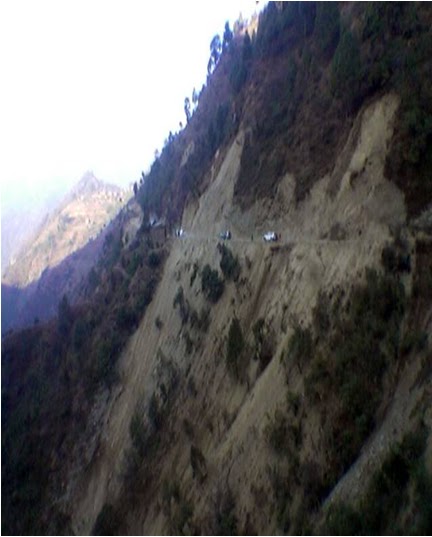
Hhahaha, just kidding. This is actually a very nice road. It’s paved. And a lot straighter than most of the single lane “highways” we traversed as we slowly wove our way up the steep mountain slopes to what is understandably known as the roof of the world. Even from where we were at approximately 3,000 meters, the physical presence of the snow capped Himalayas is truly awe inspiring. Even though it’s monsoon season, the clouds cleared enough on that first day for us to see the real mountains, towering above us, so close I felt like we were tiptoeing at the feet of giants. 

If there are two things to be said about this drive, they are that: 1) the views were absolutely incredible. Everywhere I looked I saw stunning, lush green valleys with waterfalls springing out of the sides of mountains. And 2) wow was it ever terrifying at moments!


Sometimes we were scared for others...like all the times we passed tourist buses flying around the sharp corners of the steep mountain passes, crammed full of people with young men and a few goats bumping along on the roof (if only it were a joke). At other times we were definitely scared for ourselves. At one point on Day 1 we came to a roadblock where a tourist bus had broken down on a diagonal across the narrow dirt road. Cars were back up on either side of it. I could visibly see the driveshaft broken off of the front axle and lying on the ground under the bus, so it was clear that the bus wasn't going to be moving any time soon. We waited for about five minutes, watching young men peering under the bus and running around trying to figure out what to do before our driver muttered something in Nepali, sparked the engine back up and pull around the other waiting cars, towards the bus. It was clear that she intended to try and get around it. On the side away from the mountain; the one that dropped off. My side.

As Man Kumari approached the bus, I looked at my phone and wondered if I had enough time to text my mom and ask her to tell everyone I love them if I go down. Then, in that moment when I felt my side of the vehicle get slightly lighter as it literally teetered on the edge of a cliff, I decided that I didn't. But hey, it wouldn't be Nepal if I didn't seriously consider the fact that it might be the last day of my life at least three times a week.

Tanya spent a good portion of that first day with her eyes closed when something exceptionally sketchy or dangerous was happening. We joked that I would get her a sleeping mask and just pull it over her eyes when I saw danger approaching so as to keep her calm.
“Damn it. I should have written letters to my loved ones to give you, just in case.”
I looked at her incredulously. “What makes you think I’m going to survive?!?!” That gave us a good, hearty laugh, one of oh so many over those four days in Dolakha. It’s funny how nerves and intense panic can manifest themselves sometimes, isn't it? Personally, I think laughing about our extremely diminished level of personal safety was the best way to go. If you have to laugh or cry, I think it’s always better to laugh.

It would be impossible for me to relay everything that happened, because it was just far too much. We met so many people and visited countless enterprises over those four days, but I will expand on some of the highlights. The first day was a MEDEP day. We criss-crossed the district that Sunday, visiting fabric processing, bag making, weaving and photography micro-enterprises, among others. In typical Nepali style, we were welcomed warmly everywhere we went with garlands of flowers and scarves. While I understood that this is simply a Nepali custom for greeting honoured guests, in some ways it made me feel like we were being accorded too much importance. Not that I consider myself to be unimportant, but I developed a heightened awareness of the potential expectations our visit might be creating for what we were going to be able to do for these people. I made an effort to manage those expectations through the interactions we were able to have, by stressing that we were here to gather information and get ideas about the potential intersections between micro-enterprise and disaster risk management. To be perfectly honest, I don’t know how clear that was, as communication barriers were one of the main challenges we faced on that trip. Thinking about it still brings me some concern. I suppose the only thing I can really do to put my mind at ease is to take what we learned in Dolakha and turn it into something real, something useful.
Tanya and Bina after being welcomed at Dhaka fabric weaving enterprise training site


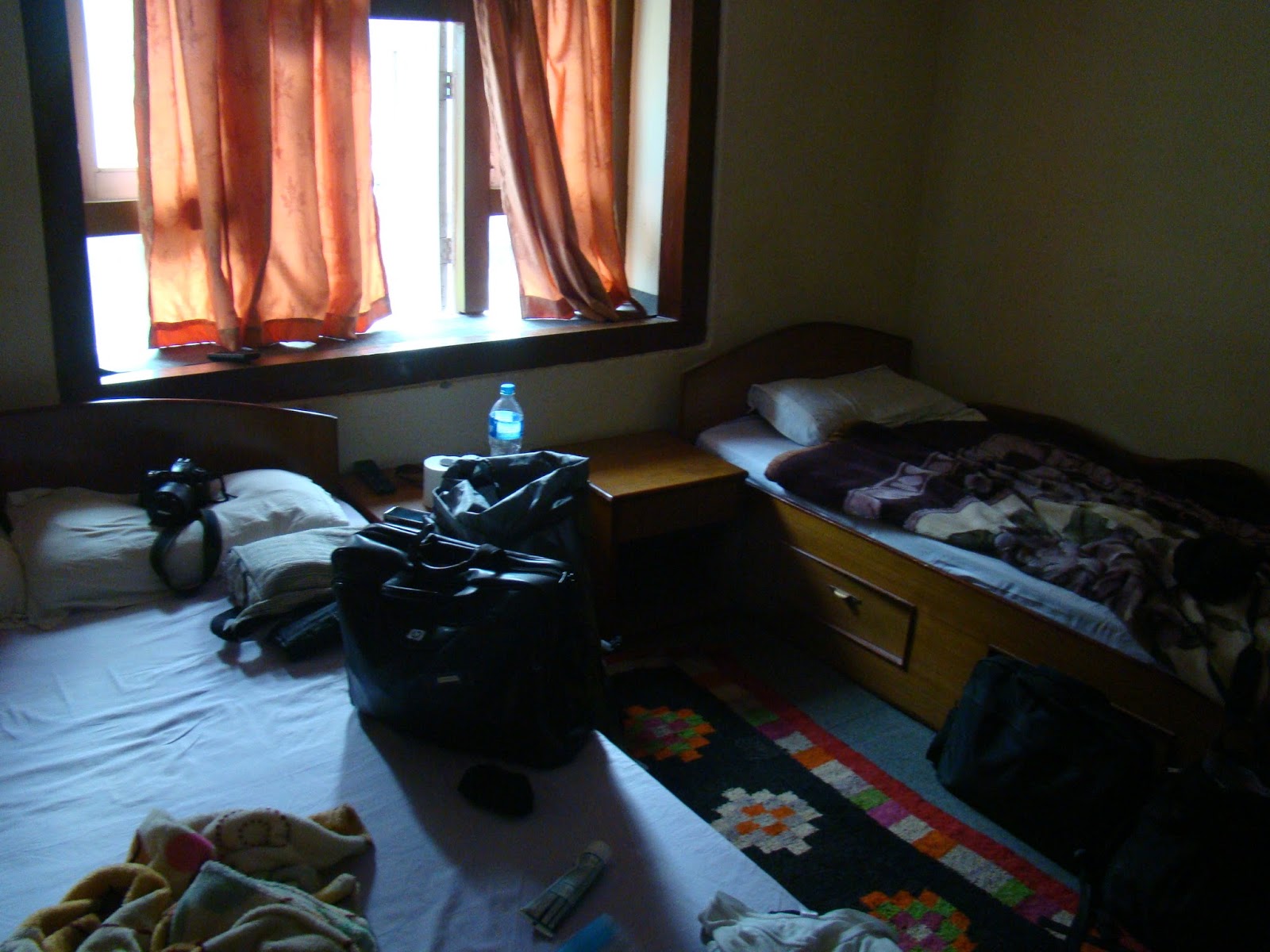
By 6:00 pm on the first day we had made it to Singoti, our resting place for the night, and checked into our “hotel”. To be perfectly honest, we had been preparing for the worst, so it was a slight step up from that. I was just thankful that the place wasn't hanging over the edge of a cliff, held up by a few timber beams, as was the case with a number of other roadside hotels we had passed throughout the day. Despite that, the beds felt like they were sacks stuffed with straw, barely covering a wooden plank, the provided bed cover was a dirty old kid’s fleece blanket, there were a couple small lizards scurrying around the walls of our room, the entire town was utterly devoid of internet, or even cell phone reception, and when I sat down on the common room couch to get some work done I noticed goat droppings beside me. But man...was it ever cheap!!! They served us dinner (dhal bhat, obviously!), breakfast the next morning and lunch (dhal bhat...what we ate nearly every meal for four days) and it came to under $20 including the room for the two of us. Nevertheless, I can’t say it will be top of my vacation hot spots.

Day 2 in Dolakha was disaster day, and our schedule’s focused shifted from visiting MEDEP projects to Disaster Risk Management projects, partners and a disaster site. Over breakfast Bina went over the schedule with us, and suggested a last minute change.
Bina – “The road is not good to Sorung Khola. If we go there we will have to walk two and a half hours in and two and half hours back. WE will get back late and stay here again. Instead we go to Lapilang. We only have to walk 15 minutes in and 15 minutes back. Then we stay in Charikot tonight.”
Tanya and I stared at her blankly. The one place Tanya’s team told us we HAD to visit was this Sorung Khola project where farmers had been supported to cultivate Cardamom and Broom Grass as a small enterprise because they were exceptionally good at preserving soil integrity and preventing landslides. This last minute change wasn't going to fly.
Bronwyn – “I’m not sure if that will be possible. We were told we really had to see Sorung Khola,” I started diplomatically; as much as it pained me to condemn Tanya and me to another night in the luxury hotel of Singoti.
Bina – “It’s same. We can go to Lapilang. They have Cardamom and Broom Grass.” This seemed like something didn't add up. After a few more minutes of strained conversation it became apparent that there were three locations of this particular project. Tanya and I wondered: if it was so much easier to get to the Lapilang location why hadn't we been told to go there in the first place. We decided it was safest to get guidance from home base on the change, so we asked to use the hotel’s landline and called Tanya’s supervisor. He confirmed that it was fine to change our itinerary, especially if it was more accessible and would get us back to our hotel before dark. In the end, good luck was on our side, because as we drove towards Lapilang later in the day Bina received a call reporting that there had been a landslide in Sorung Khola earlier in the day. And so Nepal delivered us, once again, from another near miss.

Before we made that trip though, our first order of the day was to visit the Local Disaster Risk Management Committee at the site of a large landslide that had killed a family of four a mere 15 days earlier in the nearby village of Marbu. When we went to get into the car, we realized that we had accumulated quite the entourage. It seemed everyone from ECARDS (the local disaster risk management project partners) was interested in going to see this landslide site.  So it ended up being Man Kumari driving, two men squished together in the passenger seat, Tanya, Bina, myself and Bimal (the ECARDS project lead) in the back seat, and another man crammed into the hatch back with all our luggage.

The road to Marbu was by far the worst we drove on the entire trip. There was just barely enough room for the Land Cruiser along what should have been the hard-packed dirt road, but had instead been transformed into a ragged, mud slick with the monsoon rains. We bumped along in our overloaded vehicle, so close to the edge that, had the car stopped, it would have been impossible to step out of the left side without falling two to three hundred feet directly into the gorge of the raging Singoti river below.

Tanya and I had broken out, periodically, into our nervous laughter again as we avoid contemplating what seemed to be our imminent death.
“Are you afraid?” Bimal inquired from the other side of the back seat. The side not staring directly down into the gorge.
“Uhhh....welll....just a little nervous...” He nodded understandingly.
“Yes. This is my first time coming here by car. I am also a little afraid.”
Wait...what?
“How do you normally come here?” I asked, looking at him incredulously.
“I walk.”
“Really? How far is it?”
“12 kilometres.”
TWELVE KILOMETERS!!!!!
It became immediately apparent why we had so many people crammed into the vehicle, this was their only opportunity to visit this community without walking a half marathon. It also immediately brought two fundamental questions to my mind: 1) If the locals don’t find it safe to travel here by car, why the hell are we doing it?” and 2) How does the community get access to the basic essentials of life? 

Singoti Hospital
One of these questions had been answered, in a way, before we even began the treacherous journey to Marbu. As we pulled off of the main road we passed a young man rushing down the road, carrying an uncomfortable looking older woman, piggy back style, flanked by two other women.
“He is taking her to hospital,” Bina answered our unasked question. Similarly, the following day, as we stopped for tea in a small mountaintop village we saw a woman lying on the ground with a crowd gathered around her.
“Is everything okay? Does someone need help?” I asked Bina.
“Oh yes,” she replied breezily as we watched four men hoist her up on a makeshift stretcher, made of dense cloth pulled tightly over thick branches, and jog off down the road, bouncing her along. “She just had baby. They’re taking her back up the mountain to her home now.”
“WHAT?” I was unable to hide my shock. “Where is the baby?”
“Green blanket.” When we turned back to look we saw the young woman running after them with the green bundle clutched in her arms.

When I was a teenager I used to think that I lived in a remote area, deprived of the essentials city dwellers took for granted because the Huntsville Place Mall only had one good clothing store in its tiny mall. Thing like ambulances, hospitals, police and road safety seemed so fundamental their existence was never questioned. Can you imagine carrying someone 12 kilometers on your back, through mud, up and down hills and across rivers when they urgently needed to get to a hospital? How about being carried 12 kilometers when you are critically ill or injured? Can you conceive of giving birth to a baby and then being jolted around by the unsynchronized running of four men up a mountain? This is the reality of everyday life for 75% of Nepal’s population, who live in rural communities, so remote that access to the basic essentials of everyday life is a luxury at best, and impossible in some cases. To me, there is nothing that can more clearly illustrate the challenges associated with providing services and delivering development programs to the people of Nepal than that man carrying that woman to the hospital.  

But back to the landslide for now. Perhaps unsurprisingly (considering I am writing this) we did, in fact, make it to the site of the landslide. In fact, we drove straight across its deadly path and into the tiny community. Looking up at the towering track of earth and rocks, cut sharply across the otherwise lush, green mountainside on our right and down the same track into the river below on our left, knowing that we were driving on the graves of an entire family was not an experience I can put words to. Yet, despite the freshness of their loss, only 15 days earlier, the people still came out to welcome us, to talk to us, to show us what had happened, and what they had done in the aftermath. The Local Disaster Risk Management Committee (LDRMC), established with the support of CDRMP, took us up the hill to a vantage point where we could survey the full run of the landslide, in all its enormity. They explained that one home had been wiped out completely, and that eight others in the area had been evacuated.
Bimal - “The Committee has a small fund for evacuation and relocation, and from that they were able to provide 2000 rupees for each home that was evacuated and 5000 for the home that was destroyed.” That’s about $20 and $50 respectively.
Bronwyn – “How much does it cost to build a new house?”
Bimal – “About 100,000 rupees.”
Bronwyn – “And the house that was destroyed? Where does that 5000 rupees go?”
Bimal – “Hmm, yes, they are trying to decide what to do with that money now. There is one, 15 year old daughter who was not there because she was away studying. There is no high school near here. They are hoping to make an education fund for her because there is no one to pay for her school now.”
Bronwyn – “Who is taking care of her now? Is she with other family?”
Bimal – “No. There is no one else.”

So what does a 15 year old, in Nepal, with no family and nothing but $50 to support her do? What would a 15 year old in Canada do? My guess: just find some way to survive. As is probably all too obvious: this is not a very forgiving climate to do that in.

The Committee also filled us in on their plans to blast a massive boulder, perched precariously in the mud some 500-600 meters above us. They explained, though it was not necessary to do so, that if they don't bring it down, it could fall on its own at any moment. As I peered up the steep slope I noticed several little blue dots bobbing across the mud, and soon realized they were school children in uniform. Upon closer inspection of the surrounding area I realized the hill was dotted with people everywhere.
Bronwyn – “Who are all the people up on the hill?”
Bimal – “They are members of this community.”
Bronwyn – “I thought they were evacuated after the landslide.”
Bimal – “They were evacuated, but they come back every day. The only thing they don’t do here is sleep. So really, they are here most of the time.”
Bronwyn – “Why? Isn't it dangerous.”
Bimal – “Yes, but this is their land. These are their crops. They don’t have any other choice.”

The truth is, they brought us here because this is a good example. This is a case where the LDRMC was already established, and responded as it was intended to. Marbu is a success story.  Sometimes in development, the gap between project “success” and meeting needs still looks and awful lot like a canyon.

When we had made our way back down the hill to talk to the broader community a young woman made her way down from working the crops with a baby in a bassinet suspended behind her by a thick strap across her forehead and another small child in tow. I decided that this little girl would be the first recipient of one of my bears that I had tucked away in my bag in the back of the land cruiser. When we had finished talking to the LDRMC and other members of the community, I asked Man Kumari to open the car quickly before we left and retrieved Osito, a red bear with a Mexican flag on his chest. To be perfectly honest, Susilla seemed quite sceptical of both me and Osito. The adults surrounding her smiled and cooed, appearing delighted with the gift. They encouraged her and laughed as she shyly hid her face when I held the bear out to her. I left Osito with Susilla’s mother who began animating him to play with the infant in her arms. As we drove away everyone from the community smiled and waved to us, but Susilla remained looking dubious. I could only hope that eventually she would warm to Osito.

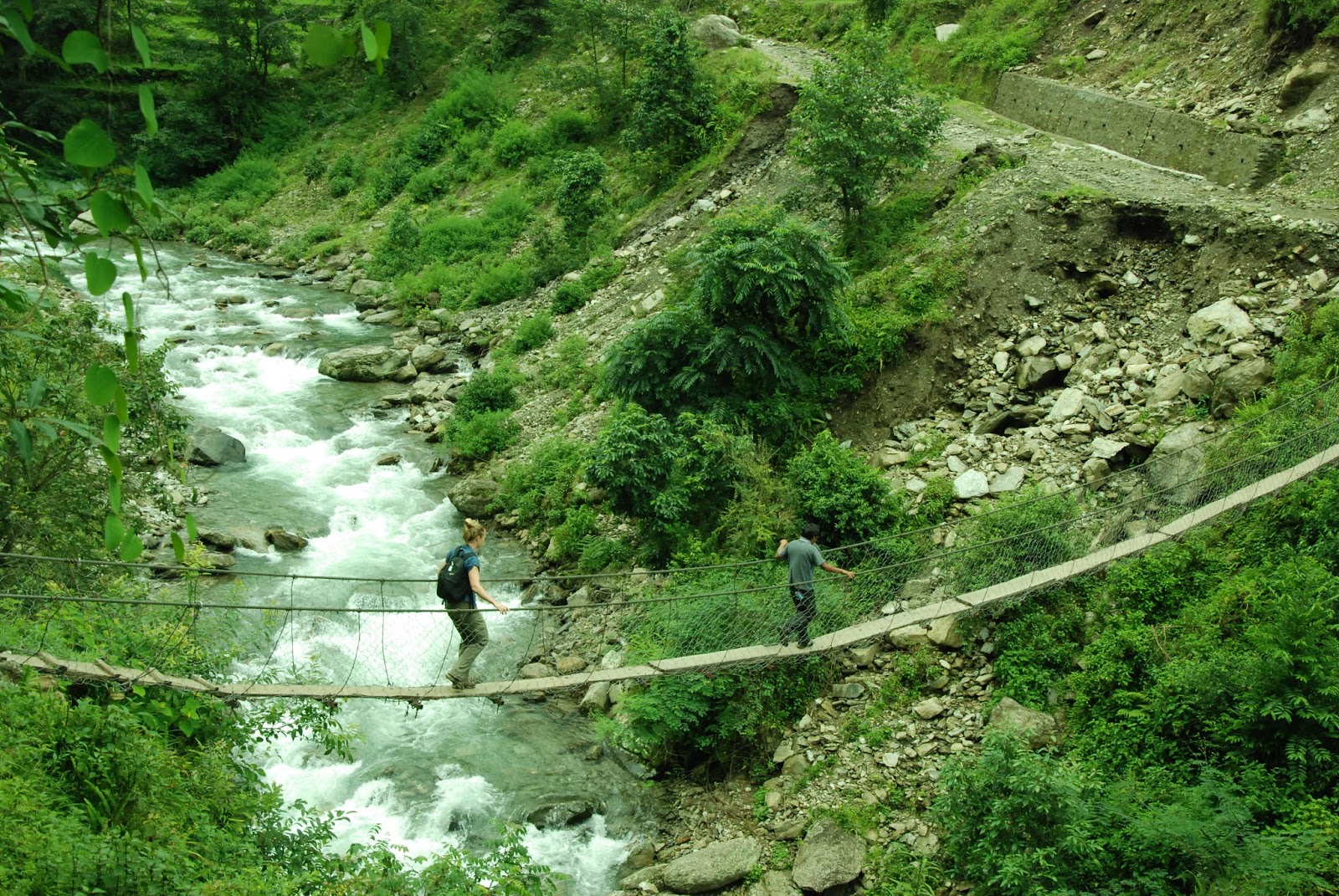
Later that same day, after some hiking and a few skechy bridge crossings we made it to the Cardamom and Broom Grass plantations of Lapilang. From the cooperative meeting space we hiked upstream and back viewing the crops for an hour and a half. For the first hour Tanya was enchanted, proclaiming that it was the most beautiful place she had seen in Nepal yet. Ten minutes later she realized we were both covered in leeches when she felt the tell tale pinch around her ankle and had to start ripping them off as they advanced up her pants and boots. I rolled up my pant leg to find I was too late and my right sock was already soaked in blood.
“Okay, this is sick. Let’s get the hell out of here,” she proclaimed in a hushed tone to me.
“Shall we see more?” Our guide, a local soil conservation officer, inquired innocently. We just stared at him, wide eyed like: Stoooop it! This was entirely justified because every plant we had seen was...the exact same.
“I think that’s enough. We can go back now.”
“Hmmm,” He cast his eyes downward and looked disappointed, but begrudgingly led us back.

Upon returning to the meeting space we sat down with all the cooperative members to discuss what kind of demand they had for their crops, what their future goals for expansion of business were and how effective the plants had been at maintaining the soil quality. Here too there was one woman with a small child at her side. Deciding that I was on a bear giveaway roll, when we had finished our conversation and were preparing to leave I slide down the bench towards the young boy and his mother and pulled Fuzz out of my bag. Once again, while his mother smiled, he met the sudden appearance of a stranger holding a bear out to him with the same hesitance as Susilla and buried his face in his mother’s side. The our soil conservation officer friend, who apparently had suddenly decided we were in a rush tried to speed up the process by taking the little boy’s hands and forcibly making him take Fuzz from my outstretched hands. This, of course, prompted an immediate outburst of screams and sobs. So yeah...basically the exact reaction I was going for! I sheepishly backed away slowly, apologizing.

Once outside and on our way back to the vehicle I said somewhat disappointedly to Bina: “The kids really don’t seem to like the bears.”
“No, no, they like.” She tried to reassure me. I gave her the same sceptical look the children had greeted me with. “It’s just that they have never imagined that such a thing could exist.”  That was a factor I had never considered. Needless to say, I decided to re-examine my bear giveaway strategy before scaring any more Nepali children for life, and turned my focus back to work.

That night we stayed up working until 10:30 in the restaurant of our hotel in Charikot because our minds were so full and there seemed to be a true urgency. By day 3 we were getting tried. We met more entrepreneurs, ate more dhal bhat and spent the night in Jiri, the Everest Gateway – where the road stops and people who don’t want to fly to the Tenzing-Hillary airport start a 7 day trek up to it. By the end of that day all Tanya and I wanted to do was sleep for hours (after a few emotionally and physically draining days without really sleeping due to mattresses that I am fairly certain were made of straw and woodchips and enforced 4 or 5 am wake ups as a result of dog fights, tourist buses, roosters and general hotel hubbub), but alas that was no in the cards for us, as Bina had other plans. So instead we visited another MEDEP outlet, a large stupa, took a stroll around Jiri and then sat out on the deck of the hotel with the ladies snacking on local vegetables with chilli and some local alcohol. At this point, I just went with it, despite the fact that I had no idea how that massive cucumber was washed and I have been told time and again to NOT drink local roxi (liquor). If I had survived this long, what’s the worst that could happen?

Bina – “We are all going to have some local alcohol now. Just a little. We will all have little drink.”
Bronwyn - “Bina, have you ever had roxi before?”
Bina- “No, never!” she giggled. I became slightly concerned.
Bronwyn - “At all?”
Bina- “No. No beer. No wine. No roxi. First time!” She proclaimed happily, and down the hatch the questionable and strong green liquid went. Ahh crap, how is this going to turn out?


When all was said and done, we saw many linkages between poverty and disaster vulnerability that helped shape our ideas about our project. It was an incredibly valuable trip. However, I must admit that by the time the LONG trip home on that last day was finally over I was exhausted, sweaty, felt as though I was likely covered in a thin layer of urine (from all the disgusting toilets I had to use with the only hope of washing up being: fingers crossed there’s a stream nearby) and never wanted to see another plate of dhal bhat again in my life. When I woke up peacefully in my own bed the next morning I uttered a sentence I never thought I would: “Ahh, it’s so nice a quiet here in Kathmandu.” Perspective’s a funny thing, isn't it?

Monday, August 19, 2013

Working ON The Weekend

Work: it’s about time I write something about it, eh? Oh how quickly “working for the weekend” turned into “working on the weekend.” Ahh, well – it’s all good.

I've been working for the Poverty and Inclusion Unit at the United Nations Development Programme Nepal (one of six thematic units, which include: Poverty; Climate Change, Environment and Energy; Governance; Disaster Risk Management; Peace Building; and Strategic Planning) for a month and a half now. I didn't write anything about it at first because I didn't have much to say that was substantial – it took a while to get rolling with work. I haven’t written anything about it recently because I've just been too busy! Something I am very happy to report.

The office: UN House.
I’ll start with what my unit does, and then I’ll tell you a little bit about what I have gotten myself buried in (buried in a good way, I promise). The mandate of the Poverty and Inclusion Unit is to promote sustainable and socially inclusive economic growth in Nepal through the alleviation of poverty. There are two components to the unit’s work: policy support to the government in helping them create interventions that are “pro-poor” – in other words: ensuring that government policy and programs take the poorest, most disadvantaged and socially excluded in Nepalese society into account; and grass roots programming to support poverty alleviation in the rural areas of the country. These programs are centered on livelihood support in the most impoverished districts and communities of Nepal, including a Livelihood Reduction for Peace program (Nepal is still recovering from a recent 10 year armed conflict from 1996-2006 and income generation is one strategy to reduce incentives for armed conflict in extremely vulnerable districts) and a Micro-Enterprise for Development Programme (MEDEP). MEDEP has been one of UNDP Nepal’s flagship programs over the past 14 years of its operation, hailed for its success in over-delivering, lifting thousands of Nepal’s most vulnerable people (women, untouchable castes, disenfranchised youth, disabled, religious minorities, and conflict and disaster affected families, among others) out of poverty.  Nepal has been successful in reducing absolute poverty over the past 20 years from 42% to 23% living below national poverty line ($230 USD/year – about .63 cents per day) – however, inequality has increased and the poorest segments of society have only become more impoverished as other have risen out of poverty. That is why the MEDEP project aims to target these most disadvantaged groups.

I have gotten involved in the “upstream,” or policy, aspect of the unit’s work, by aiding in the preparations for the fourth national review of Nepal’s progress on the Millennium Development Goals, which has been a significant undertaking. We’re in the home stretch with that one now though, as it’s due to be launched on September 10th, and then we’ll dig into preparing the Nepal Human Development Report, which will be an even larger project. I have also been involved with the MEDEP project by helping finalize documentation to bring the project into its fourth phase. As I mentioned before, MEDEP has been a very successful UNDP project for the past 14 years, and currently operates in 38 of 75 districts across Nepal. As its success has been admirable, the Government of Nepal wants to adopt its approach and take full ownership of the project, using it as a poverty alleviation tool all across the country by implementing it in every district. This fourth, and final, five year phase of MEDEP will focus on transitioning the project from implementing the model to facilitating the government’s implementation of it. AusAID is the biggest donor to this project, and has allocated about $32 million for the fourth phase. So basically we’ve got: UNDP, AusAID and the Government of Nepal, who all have to agree on the terms of this arrangement and sign the 150 page project document and cost sharing agreement in order for the project to go forward. To really heat things up as we came down to the wire to get this agreement signed, our AusAID contacts told us that because Australia was about to head into an election we had to get it signed in the next week or it likely wouldn’t happen. No pressure.

So it’s Tuesday. AusAID has agreed on the text of the project document, and all we needed was to get the Ministry of Industry (MoI) to sign off. My boss has left the office about 45 minutes earlier to take the document to be signed when my phone rings. It’s Nabina (my supervisor); she asks if I’m busy and tells me she’s going to send a car for me because she needs my help down at the MoI. When I arrive she is sitting with the Joint Secretary of the MoI, the National Programme Director (Government representative on the project) and the National Programme Manager (project lead) with her laptop open to the document. When I sit down beside her she tells me that the government wants some changes to the document, and she wants me to make them as they go through it so that we can get it signed today. Okay, makes sense, I think, and take over on her computer.  It takes all of 60 seconds for me to realize that they are currently on page 7 of 150 and reading the document line by line. LINE. BY. LINE. And she thinks we’ll finish this today? Oh my god, I am going to be here until tomorrow morning! So we start slogging through the jargon, and they are debating every tiny little detail. I soon realize that the government people are asking to change words that they don’t like, or don’t fully understand. It’s doesn’t matter if I explain the meaning of the word, they want to change it to a word they are more familiar with…as if they don’t understand that different words mean different things and you can’t just swap words without altering the broader meaning of entire sentences and paragraphs. And that’s not even the best part! The best part is that all of this negotiating is going on in Nepali. So we’ve got four people heatedly debating a massive document, phrase by phrase, in Nepali, and me, behind the keyboard, supposedly keeping up with these changes. Because everyone was aware of how much there was to do they wanted to move through it quickly and once they had agreed they would just move on, look at me quickly and ask: “Got it?”

WHAT? NO! Of course I don’t ‘got it’! How could I have it? At this point I started looking around the room thinking: Ashton? Where are you hiding? Am I being Punk’d?
Alas, by the time we reached page 30 the Joint Secretary exclaimed thoughtfully: “You know, maybe it’s better if we all go home, read over the document, make notes and come back tomorrow to go through the notes quickly at that time…”

How this was a concept that was just dawning on him is still absolutely beyond my realm of comprehension. Ahhh but alas, at the 11th hour it all came together and we got the signatures we needed to move forward with MEDEP for the next 5 years. You can all expect Christmas gifts made by poor and marginalized MEDEP micro-entrepreneurs this year!

In my little corner at work...desk a disaster, as usual.

The final thing I have gotten involved in is a new initiative that another JCP, Tanya, and myself are trying to get off the ground. Tanya works in the Disaster Risk Management Unit, and is very interested in poverty alleviation. Similarly, I am very interested in issues of environmental risks. At the Canada Day party Tanya and I got talking about how we saw a lot of points of intersection between our two projects, and agreed to explore writing an article about them, on our own time. When I ran this idea past my boss on Monday morning she took it a step further: “Or, if you have a good idea, you could draft it and we could present it to Senior Management. If they like it we could do a pilot in the field.” What? Seriously?  I did a major double take when I heard that. Within the hour I had talked to Tanya about it and we agreed to move forward and see what was possible. Everyone we turned to for guidance and information was supportive over the next could weeks as we began to shape our ideas and draft a concept note. I was so impressed and surprised to see how much room there seemed to be for this type of initiative. What we came up with, in a nutshell, is a two part plan with both long and short term objectives to better mainstream disaster risk management principles into micro-enterprise development, in order to protect the sustainability of fledgling enterprises in this exceptionally disaster vulnerable country. We see the current status of MEDEP, a hugely successful program on the verge of being implemented nation-wide, as a perfect window of opportunity to make some small changes to its delivery that will, hopefully, have a large impact.

We presented our initial ideas at a meeting with both of our supervisors, as well as other stakeholders from both projects, a few weeks ago, and once again, the response was shockingly positive. Not only were we given the green light to move ahead, we were encouraged to back up our concepts with concrete experiences by going to the field and observing the linkages between disaster and poverty for ourselves. So that’s what I’m working on now: helping out where I can with policy and program work, as well as trying to push Tanya and my pet project out of the nest and hoping it flies in the next four months before my contract comes to an end.

Stay tuned for my report on my first trip outside of Kathmandu to Dolakha district with Tanya for our project – as well as my first bear giveaways (spoiler alert: as with everything in life, it didn't go exactly as I had pictured it).

One thing that I have really learned in my two months working here is how important building trust and good relationships is to getting work done. People here not only care a great deal about their work, they can even be very protective of it in some circumstances. Until someone trusts you they won’t let you be a part of what they’re doing. I was even once asked to leave a big meeting that was directly related to what I am working on because the leader of the meeting didn't believe there was any value in me being there (she’s not someone I work with directly). She claimed that it was because she wanted to conduct the meeting in Nepali; however, I think given my earlier story it’s fairly clear that that’s a bull sh*t excuse. That’s part of the reason why work was a bit slower to get rolling than in other jobs I have had. I spent a good amount of time just softening people up and focusing on building their trust in me. But once I got in with them, and they knew they could rely on me it was like the flood gates opened completely. Now I often find myself pulling a Nepali work week (Sunday to Friday). But it’s okay. I like what I’m doing, so it doesn't feel like a burden.  

Tuesday, July 23, 2013

Working for the Weekend


There has been no shortage of things to keep us occupied here in our first month in Nepal. So much has happened that it feels more like a year than a mere month. Every weekend is too short (that’s definitely the same as at home) with too many things to see, do and explore. Two weeks ago, team JPC (Taryn, Sean, Jess, Tanya, Micah and myself) decided to get out of the city for a day and check out a rice planting festival. We hoped on a bus bright and early on the morning of Saturday, June 29th, along with a number of our new Australian friends, and within 45 minutes were bumping along down washed out country roads amongst a sea of green rice paddies.

When the monsoon rains begin to fall on Nepal in the summer every year, the rice season commences. Rice is not only a major dietary staple for Nepali people; it is also an essential means of livelihood for many farmers across the country. Traditionally, the last Saturday in June is the first official day of the rice-planting season, and the famers celebrate the return of the new season by planting, and playing in the mud. Unfortunately, we learned that the tradition of playing is dying out now, but we did our best to keep its spirit alive.

When we first arrived three busloads full of foreigners sidled up to the edge of the empty paddy, all wondering what we were supposed to now. As we all tentatively made our way through the muck, local women tried to instruct us on how to turn up the “soil” by scooping up bits of debris dropping them in a pile and stomping them deep beneath the mud.

Seriously?

Based on the fact that what appeared to be the entire population of the small village had gathered on nearby rooftops to gawk at us, it seemed equally likely that this “weeding” technique was usefully as it did that they were screwing with us. However, this didn’t last long, because it was only a matter of minutes before the first of the mud started to fly. This quickly gave way to all out mud wrestling matches. Once I was dirty I became fully committed to the cause of ensuring every other participant became equally mud-covered. In my mission, I suffered an especially amusing defeat against Tanya’s husband Micah, as immortalized on video by Sean, here:

I felt a bit guilty about getting side tracked from the “weeding” at first, but when I started to notice just how smooth the mud was getting I realized that it might have been part of the master plan for turning up the soil after all.

Once the paddy was in the right shape to be planted we were called away from our games and handed bundles of rice stalks. The next 45 minutes were occupied by trying to stick the individual plants up in the mud without royally screwing up these people’s future rice harvest. I do not think I have ever heard “No! Like this!” (followed by a demonstration) more times in my life than during that period. It didn’t help that everyone seemed to have a slightly different version of like this. When my rice bundle was all (or at least most) stuck upright in the mud I happily retired to the waiting snacks and rice beer. I can say with complete confidence that the local women were relieved to get us out of the way. They were literally reaching over me to plant in front of me I was going so slow (oh yeah, and to re-plant a few of my first attempts at times as well).


After snacks and beer it was time for the real games to begin! At first we were reluctant to hop back into the mud, but the organizers soon had a fairly sizeable group divided into two teams for what I can only describe as a combination of capture the flag, tag and ultimate mud wrestling championship. In reality, the game is called Kabaddi and what happens is one person crosses the centre line and attempts to tag a player from the opposing team then dart back across the line to safety on his or her own side without being taken down by the opposing team. If you get taken out by the other team, you’re out. However, if you manage to tag someone and get back across the line the person you tag is out, and someone from your team gets to come back on. It got a little intense at times....


But it was definitely fun!


After the mud wrestling had run its course as we had all managed to “shower” under village water taps and streams we loaded back onto the buses and went to a local restaurant for a traditional Newari (the native people to the Kathmandu Valley) meal, followed by a relaxing stroll through the hills before arriving, exhausted, back in the city a few hours later. That might have been the deepest sleep I have had since arriving.


The only really low point of the day came when this conversation transpired:
Tanya – Hey, did anyone else notice that as we got closer to the edge of the paddy it started to smell like poo?
Micah – Yeah, I went to use the public washroom at the end of the day and it was basically just on the edge of the paddy.
Bronwyn – WHAT? Oh my god! I got it in my MOUTH!!!

Other fun weekend activities that we have kept ourselves busy with have included a great hike up part of one of the local mountains, a Canada Day barbeque and (of course) flip cup tournament and some regular Saturday brunches at a beautiful oasis like restaurant and organic farmer’s market.
1905, our new regular Saturday morning brunch spot
Last weekend we took a jam packed micro-bus (Jess counted 22 people at one point) all the way across the city to Budhanilkantha, at the foot of Shivapuri national park and hiked up the mountain to Nagi Gumba, a female monestary, and back. Even though we ended up getting monsoon rained out on our hike back down it was incredible to get a few hours of fresh air and relief from the Kathmandu dust and smog, as well as take in some amazing views of the city from above.
Inside Nagi Gumba
Beer Pong Team Russel(l)
POUTINE!!!

JPCs overlooking the valley from Nagi Gumba when the skies were clear, and a random man claimnig shelter under Jess and Sean's umbrella.


On “Canada Day” (actually June 30th because it was a Sunday and no one had Monday off) we took a cab across town to the home of two Canadian girls who are in Kathmandu for an internship with Mines Action, and did they ever put on a good, authentic Canada Day celebration! It was so nice to see their patio full of red and white outfits (worn not just by our Canadian friends, but the Aussies, Germans and Americans as well). With all the changes in my life recently, I hadn’t given Canada Day a second thought. Dressing in red and white and walking around downtown Ottawa on July 1st seemed like another world, another life. But I’m so glad these girls reminded me of it, because it was a really fun time, and two great seeds were planted here. One has to do with a conversation Tanya and I had about potentially collaborating to write an article about the ways in which our two units (disaster risk management for her and poverty alleviation for me) could both benefit more deeply from collaborating on a few key aspects of programming, and another was with a new friend who works at a school for children who have been rescued from forced labour in carpet factories. Unsurprisingly these children have very few belongings (perhaps two outfits each) and no toys. I think this is the kind of place that could use a teddy bear or two! Stay tuned for breaking news on both these fronts, coming to you soon!
A few Canadians enjoying some shade on "Canada Day"
Quite a good turnout for a Canadian national celebration in Nepal

Friday, July 5, 2013

Life In A Ticking Time Bomb

It is said that a major earthquake in the Kathmandu Valley could dwarf Haiti. In fact, according to the recent security briefings all us UNDP Nepal newbies just received, Kathmandu is the most at risk city in the world to earthquakes. Geological history indicates that an earthquake of such scale will occur every 75-100 years (a pattern which has held for about 1000 years). We are currently on year 79. Analysis: I have moved to a time bomb. 

So we’ve been getting the earthquake preparedness rundown. You know, the whole: drop cover and hold business. We’ve been instructed to have our emergency “go bags” with essential supplies, medical kits, water, travel documents, etc. ready to grab and get out when the looming earthquake does hit. We’re to stay indoors, wherever we are, and cover to the best of our ability until the shaking stops, then grab our go bags and get out, heading to the nearest open space where crumbling building, falling trees and power lines cannot harm us. Now, I don’t know if you have been paying attention to my photos of Kathmandu, or if you have ever been to Kathmandu, but I can assure you that in this cramped Asian city NO such place exists! 

Not exactly structurally sound
The new apartment is quite close to the UN compound, and that’s the “safe” area we’re supposed to try and get to. So, basically, what I have garnered from the massive download of information of the past couple days is that, in the event of a major earthquake (which experts estimate would level at least 60% of the buildings in Kathmandu and cause upwards of 300,000 casualties) I am to cover myself, and if the structure I am in remains standing, and I survive the initial shock, I am to grab my bag, get out and run down the street (likely while aftershocks roll across the city), trying to dodge the intensely sketchy and shoddily constructed building that will surely be falling all around me and hopefully make it to the UN. Through from there, who knows. The city of nearly 3 million has…8 fire trucks, not all of which are functional (some of them were “donated” from the U.K., which after seeing them I take to mean: dumped here from the 18th century), and few ambulances. Telecommunications will nearly all be down, and bridges connecting the city will likely have collapsed…meaning getting out of the city by air or land may not be possible. Long story short, this is the message we have gotten: “If we get a huge earthquake, which, by the way, we will, SOON, we are all screwed. Good luck! And welcome to Nepal, we hope you have a wonderful experience!”

Talk about a warm welcome :)

"We are going down here, if the earthquake happens in the next half hour, we will die." Direct quote.
This place, like many others, is going down, for obvious reasons


Surveying potential damage during our earthquake walk

First impressions of Kathmandu

It has been three weeks since I landed in Nepal, and I think the time is overdue for me to give a few of my first impressions of my new surroundings.

When we first got into the UN vehicle and left the airport, taking in Kathmandu was a shock, to say the very least. My head swivelled restlessly from side to side as I surveyed the packed streets with no semblance of order or rules of the road, the tiny, makeshift huts that passed for shops, the precarious buildings in extreme states of disrepair and the rats nests of wires wound around every pole with wide eyes. What have I gotten myself into? I wondered, involuntarily.  
Are these the kinds of places I am realistically going to have to go to buy food? A six month hunger strike seemed more fathomable to me at that point. Our guest house was in a nice area of the city, surrounded by embassies and expat homes – it is located on a mud road, wide enough for one car at a time that swerves back and forth to miss pedestrians, scooters and massive potholes (along with a few uncovered manholes). 

Allow me to give you a run-down of a few features of day-to-day life in Kathmandu. Let’s start with the traffic, shall we? I can describe it in one word: insane! The major streets are fairly wide (enough to fit two and half-ish cars across) with no lanes to speak of, nor apparent rules of the road. Instead, vehicles just go where they want and weave in and out of one another to get there. The flow of traffic is: everyone goes at whatever speed they want to (all different). The main intersections have about eight different ways of coming at them, and no traffic lights (actually, I think I have seen one set of lights...I’m fairly certain they were non-functional). Traffic police are dispersed somewhat randomly throughout the city and “direct” the traffic...sort of. They have helped us cross at times though, so they are definitely appreciated.

Every vehicle that passes anything (pedestrian, other car, truck, motorcycle, scooter, cow, bus, etc.) honks at it. Every vehicle! Every time! All the time! (Yes Dan, you were right about this). Even when walking alone down the side of a relatively wide, completely empty street a single passing car or motorcycle will honk as it passes, giving me a wide berth. As this point I am not certain if the honk is meant as a way of saying: “G’Day Mate,” “Watch out, I’m here,” or “Get the F*** out of my way.” These nuances of the honk remain a mystery to me.

The accepted manor for merging from a side street (all of which are dirt roads, only slightly wider than a car and a half) is to just start pulling out and creeping across...people seem to stop for this. To be fair: the speed of traffic is actually quite a bit slower than we would be used to in North America, so it’s not as abrupt as it might seem. This is also the accepted manner for crossing the street. Just go! The cars and vans and motorcycles and bicycles...they will all just go around you (in theory; currently, my best practices for street crossing is to sidle up to a local who looks like they’re about to cross and walk in their shadow). For that matter, this is how animals cross the street as well. And are there ever animals in the street!

Thus far, on the streets, I have seen: ducks, chickens, dogs, lots more dogs, rats (sometimes alive, mostly dead, being fought over by the aforementioned dogs), a few cats, dead crows, monkeys, cows, goats, and this morning one of my fellow JPCs saw an elephant as she was walking to work. I am a very deep and unhealthy shade of green over her good fortune at this. The most common is dogs – lots and lots of street dogs. They mostly sleep in the shade during the day. We have taken to naming the dogs along our street. Names include: Pharaoh for this really Egyptian looking one, Tripod for the three-legged German Sheppard and Shenzi, after the hyena in the Lion King for an especially scraggly, long-haired one. When the sun goes down though, the dogs come out for their nightly mass street dog convention and ultimate fighting championship. Luckily, I am a pretty deep sleeper.

All these animals are not just found along the sides of roads or on tiny side streets. I have witnessed both dogs and cows literally laying down and resting in the middle of major roads, looking completely calm and unfazed as speeding cars pass all around them. Everyone just moves over for the animals, as for every other obstacle on the road. In fact, I watched two cows cross about six lanes of traffic the other day. I should really make an effort to try and ask them how they did that, come to think of it! 


So, with a traffic situation such as this, how does one get around safely? Well, safety is a relative concept around here, so let’s not spend too much time dwelling on that. There are several options for “public” transit here (I say “public” because they are privately owned and operated as there are no city busses). If headed into the centre of the city for some evening entertainment (about 5km from my apartment) you could take a taxi for around 250-300 Rupees ($2.75-3.25 Canadian). OR for a more colourful option you could stand along the side of a major road and wait for a jam packed white cargo van looking thing to drive by with a young boy hanging out the side of the open sliding door yelling locations quickly in Nepali, hope that you flag down the right one and squish in for 15 Rupees (16 cents).
Our group of six did this one evening. We got some weird looks from the locals, and I think I might have caught a touch of TB from the elderly woman hacking up her lungs 3 inches from my face, but it was sort of fun at the same time. The tension was broken when the driver tried to ask us for 900 Rupees and Tanya yelled out: “Noooo,” very good naturedly in a way that said You’re silly, and we’re not stupid! Everyone burst out laughing then, driver included, who told us it was worth a try.

There is also the Tuk Tuk, which is an even smaller, more packed, three-wheeled version. They look a lot like they could be cardboard boxed perched on top of slightly overgrown, motorized tricycles. We have yet to try this, but trust me: it is on the list!

In terms of getting where you are going, that is quite interesting and hilarious as well. If we were able to give cabs addresses and have them take us to said addresses that would be easy, but that’s not how they roll here in Nepal. Most streets don’t have names. People find their way based on regions and landmarks. On our first day we received directions that included: “Go west to the end of this street, then take a left. Follow it straight until the banyan tree, where you should go around it to your right...” So at this stage we can never truly be sure where we are going to get dropped off, and if we can expect to be able to find our way to our destination from there. It certainly makes getting around interesting.


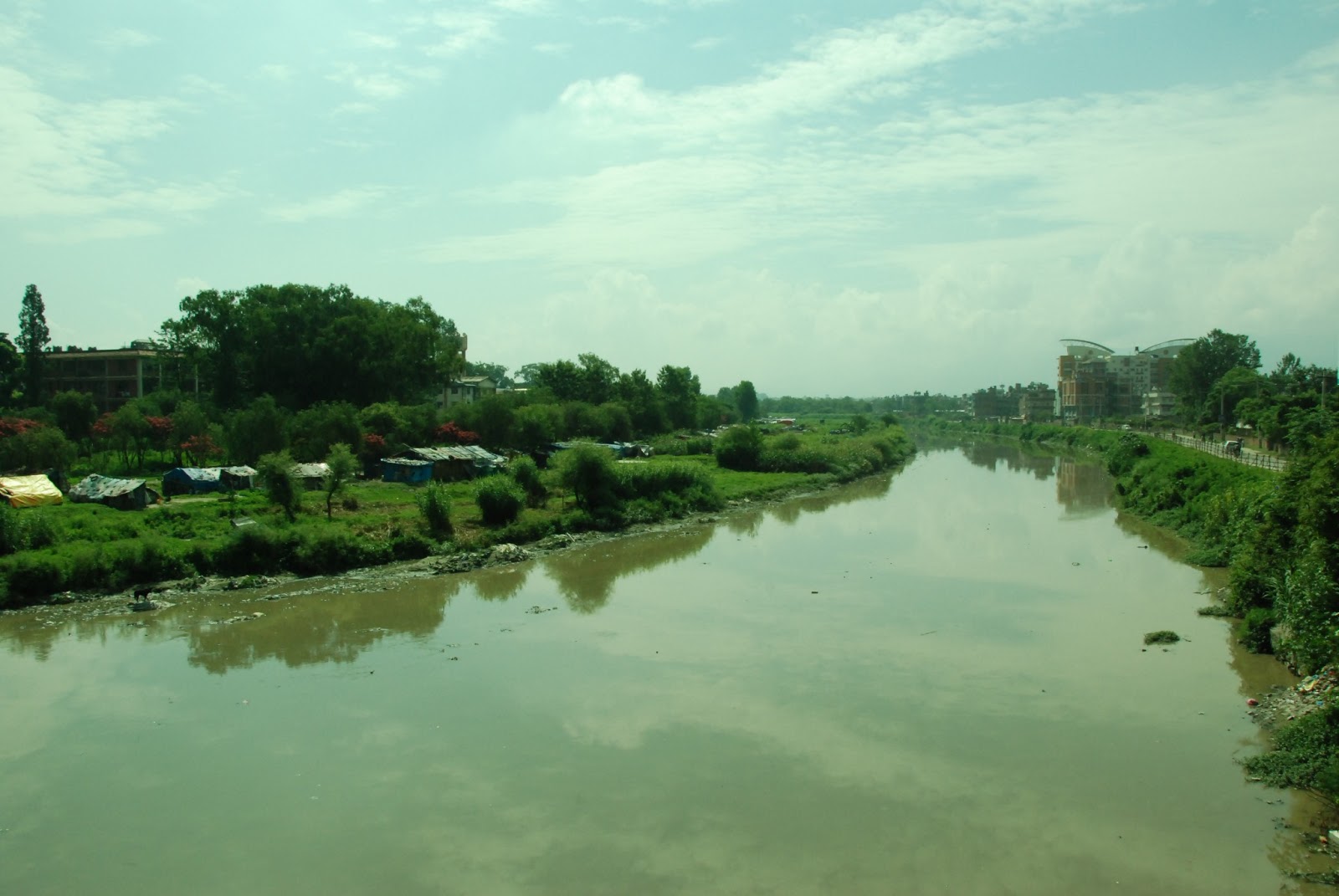
Other features of the Kathmandu streets: they are hectic, crowded and incredibly polluted. I cannot tell you how many times a big truck has driven past me and completely coated me in thick, black exhaust. Besides the air pollution, walking often turns into a game of: can you avoid the mounds of animal feces and piles of garbage between point A and point B? The Bagmati River, which separates Lalitpur (where I live) from central Kathmandu, has 300 tonnes of household waste dumped into it every day. Every! Day!


Environmentally, this is horrifying, but even worse than that is the fact that Kathmandu’s poorest people live beside the river in makeshift huts, constructed mainly of old clothes, garbage, tarps, signs and other debris. Poverty is extreme. Nepal is one of the top 10 poorest countries in the world, with 25% of the total population living below the poverty line (on less than 63 cents per day). Of everything I have encountered here, it is the most shocking thing to be confronted with. Watching people working so hard, for such long hours to make so little gives you the kind of rotten feeling in the pit of your stomach that doesn't go away, especially when you think about the fact that most people at home pay more for their cable and internet in one month than a lot of people here could hope to make in a year.


The biggest adjustments have been in the basics of living: food, water and electricity. We had a hard time at first figuring out what and where it was safe to eat (vegetables are generally out unless you wash them in iodine for 30 minutes yourself), but now we have a few local haunts for lunch and dinner. Despite the hygiene caution, we eat out a lot because everything is cheap. Lunch on a daily basis costs about $3 and we have relied on reputable restaurants for the most part since arriving as we’re just starting to gain confidence in our ability to properly wash and prepare vegetables without giving ourselves a bad case of the runs. Clean water is another concern we have been faced with.  Generally speaking: water is not to be trusted in Nepal. Even sealed water, in bottles from shops must have their seals carefully inspected so as to ensure they haven’t been refilled with filtered tap water.
Everything is dusty and dirty because of the air pollution, so the fact that your bottle is dirty looking when you pick it up doesn't necessarily say anything about what’s in it. As a matter of adjusting I have already gotten sick a couple of times from the local food/water. I think it’s all part of the process of slowing turning my stomach into a cast iron machine. It’s happening now though, I even ate salad at a restaurant without having to spend the entire next day in the washroom last week! Progress.The last thing is the electricity. The government of Nepal has a system of “load shedding”. This means that scheduled power outages roll across the city for about 8-10 hours per area on a daily basis. We are pretty spoiled at our apartment, and have a backup generator, which means we don’t often lose power for very long; however, we have, on occasion, had to prepare food or eat in the dark. Thanks for the headlamp Assia! It has proven quite handy at times.

Finally, how could I call myself Canadian and not talk about the weather? It’s bloody hot! The Nepali’s don’t seem to think it’s too bad, but I am from the great white north, and 30 degrees with 75% humidity every day has turned me into a sweaty, partially melted mess with an intense, frizzy afro most of the time. I have given up on the idea that I will ever feel truly clean during this monsoon season. Oh, and monsoon, that’s another thing entirely. It rains every day, even when it doesn't look like it will, trust me: it is going to rain! Hard! We made the classic mistake of going out for lunch without our umbrellas or rain boots on a particularly clear, lovely afternoon and ended up having to rush back to the office for a meeting amid a torrential downpour.
            “Close your mouth,” Tanya yelled to us as we ran down the street trying to dodge calf deep mud puddles. Best way to spend an afternoon, you ask? Slowly drying under an air conditioner over the course of a two hour meeting, only to realize you are coated in a thin layer of grit from the air pollution that washed down on you in the rain.  

You would think that with all these changes I would be hit with massive culture shock, but that hasn’t been the case. On the contrary: I LOVE IT HERE! One thing that really struck me within my first few days of arrival was that in spite of how incredibly different things can be from one place to the next, people are essentially the same. We humans all essentially need and want the same things. We haven’t been treated like we’re so different by people here, and I realized: it’s because we’re really not. We have been met with nothing but friendly attitudes, smiles, gracious hospitality and fabulous senses of humour. Everywhere I go Nepali people are smiling and giggling together and with others. Almost every conversation I have involves laughter. It’s hard not to be happy amid that.

Nepali culture is not abrasive. Perhaps I find that because we’re in the big city so people are more used to accepting westerners, or perhaps it’s their genuinely kind and gentle demeanours. It’s not as conservative as we were all preparing for. It is a conservative society; however, people seem very accepting of differences. They may think some things are strange, perhaps about the way we dress or act, but we don’t get harassed. I go out running in my lulu lemon shorts and people stare curiously at me, but that’s about it. The only thing I am not going to get used to is people calling me maam everywhere I go.
Good morning maam.
Hello maam.
Coffee maam?
Good evening maam.
I am not important enough to be called maam!

Perhaps I’m still in the honeymoon phase, but I find it amazing how quickly one can adjust to new things and come to love them. I already feel at home here. The mud road with massive pot holes, and a menagerie of dead and living animals along the side of it, is just “my street” now, the same way Lisgar or Woodland were my street before. The little huts with random samplings of dusty products and piles of veggies lining the precarious shelves are just my local shops where I buy eggs and beer now. Everything that shocked me and made me wonder what I had gotten myself into a couple weeks ago has come to be the new version of my cozy little existence.

I do get irritated by some things at times, of course – and the suffocating humidity and pollution that leave me in a constant state of sweatiness don't exactly help. Also, I have seriously started to consider Dad’s suggestion of just screaming “HONK” right back at cars when they wait until they’re just in front of my face and lay on the horn (as if I can’t see them approaching on the empty street or am even moderately in their way), especially when I've had a couple drinks the night before. However, at those times, retreating to the roof of my building and taking in the amazing view of Kathmandu with a cool beverage brings me right back to my happy place. All in all: life is good.